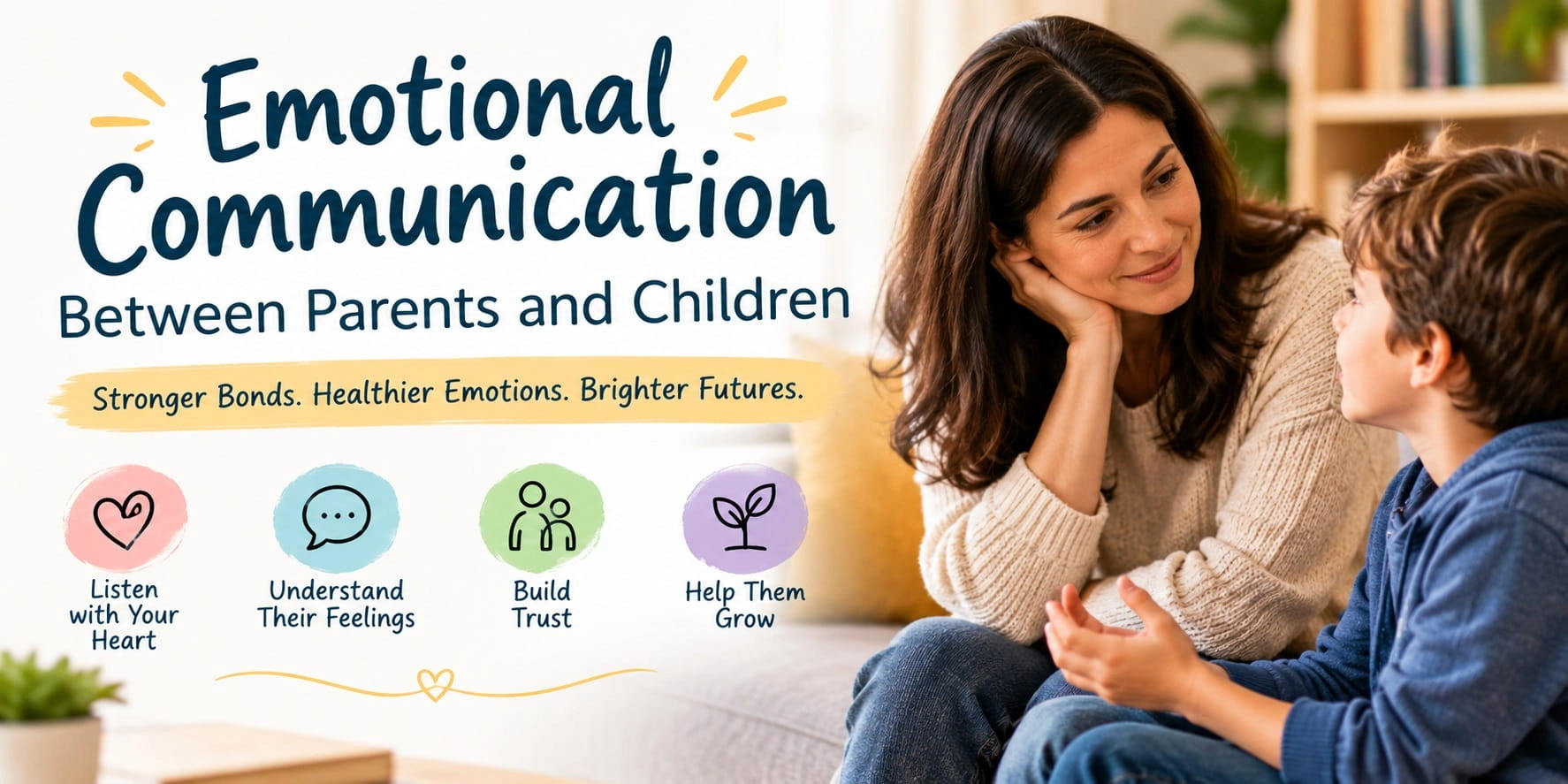



Your child comes home from school and slams the door. Your toddler melts down over the wrong-colored cup. Your teenager answers every question with “fine.” Behind each of these moments is a feeling, and emotional communication between parents and children helps you understand what your child is experiencing and respond in a way that builds trust and connection.
Emotional communication between parents and children is more than simply talking about feelings. It includes listening, recognizing emotions, validating your child’s experience, and responding with empathy while still maintaining appropriate boundaries.
This guide explains what emotional communication is and why it matters. It covers what research suggests about its effects, the core skills involved, and a step-by-step method you can start using today. It also has scripts, age-by-age guidance, common mistakes, and answers to the questions parents ask most.
What Is Emotional Communication Between Parents and Children?
Emotional communication is the two-way process of noticing, expressing, understanding, and responding to feelings within a family. It has three parts:
- Expression: how children (and parents) show feelings through words, behavior, tone, and body language.
- Reception: how well each person notices and understands those signals.
- Response: what the listener does next, whether that is comforting, validating, dismissing, fixing, or ignoring.
The third part matters most. Children can’t yet name or manage big emotions on their own. They learn to do it from how the adults around them react.
Verbal and nonverbal emotional communication
Much of emotional communication is not spoken. A young child signals through crying, gestures, and facial expressions. A teenager might signal through withdrawal, irritability, or a closed bedroom door. Parents communicate emotionally through tone of voice, eye contact, touch, and whether they put their phone down.
Emotional communication vs. general communication
General communication covers logistics: homework, schedules, chores, rules. Emotional communication covers what those things feel like. “Did you finish your homework?” is general. “You seem stressed about that science project. Want to talk about it?” is emotional.

Why Does Emotional Communication Matter in Parent-Child Relationships?
It matters because children learn to trust, regulate their emotions, and form relationships through repeated emotional exchanges with caregivers. The research below points in the same direction, though it varies in strength.
It supports healthy brain development in early childhood
The Center on the Developing Child at Harvard University describes “serve and return” interactions: responsive, back-and-forth exchanges between a young child and a caring adult play a key role in shaping brain architecture, and they support early language and social skills. A baby babbles, points, or cries (the serve), and the adult responds with eye contact, words, or comfort (the return). The center’s key-concepts page also notes that responsive relationships with caregivers help buffer children against stress and adversity. You can read more in Harvard’s serve and return explainer. Harvard University
The stakes are highest early because, according to the center, about 90 percent of brain development happens before age five.
It helps children learn to regulate their emotions
Psychologist John Gottman and colleagues studied how parents respond to their children’s emotions, a pattern they call “emotion coaching.” Research from Gottman and others found that mothers’ coaching around emotions predicted positive child outcomes, including better self-regulation skills. A later study looked at both mothers and fathers and is available in full through PubMed Central. PubMed Central
Comparisons between parenting styles point the same way. Children of emotion-coaching parents tend to show better physiological and emotional regulation than children of parents who dismiss emotions. PubMed Central
It makes hard conversations easier later
The CDC notes that good communication builds a positive relationship and makes it easier to discuss difficult topics as your child gets older. This is the practical payoff. A parent who has listened to small feelings for years is far more likely to hear about big problems when they arrive. cdc
It is protective during the teen years
The CDC states that creating regular opportunities to talk with children and youth can have a big effect on their health and well-being, and connecting with them can reduce their risk for poor mental health. The American Academy of Pediatrics makes a related point about risky behavior: trust is protective, while scare tactics can backfire and make teens less likely to come to you when they are in trouble. CDCHealthyChildren.org
What the evidence can and can’t tell us
Much of the research linking emotional communication to child outcomes is correlational. It shows associations, not proof that one causes the other. Children’s temperament, family stress, culture, and genetics also play a role. Norms for expressing emotion differ across families and cultures, so the goal is not a single “correct” style. It is a relationship where feelings can be shared safely. Emotional communication also isn’t a cure-all. It works alongside consistent care, boundaries, and, when needed, professional support.

What Are the Core Skills of Emotional Communication Between Parents and Children?
The core skills are attunement, active listening, naming emotions, validation, limit-setting with empathy, and repair. Each one is learnable at any stage of parenting.
1. Attunement: noticing the emotion before the words
Attunement means tuning in to what your child is feeling, often before they say anything. Harvard’s guidance on serve and return starts with this step: notice what the child is looking at or reacting to, and look for small moments through the day, such as while getting dressed or waiting in line. Harvard University
2. Active listening
Active listening means giving your full attention without interrupting, fixing, or judging. The CDC describes it as letting your child share thoughts and feelings without interruption, then repeating back what you heard in your own words. Its Connecting Conversations guide is a useful reference. CDC
Children’s hospital guidance also suggests asking open-ended questions that need more than a yes or no answer. Instead of “Did you have a good day?”, try “What was the best part of your day, and what was the hardest?” CHOC
3. Naming emotions
Children often feel something they can’t yet label. UNICEF advises that when a young child expresses feelings nonverbally, such as in a tantrum, you can help them put words to the feeling, like sad, scared, angry, or embarrassed. Its guide to communicating with your young child has more examples. UNICEF
Naming emotions builds vocabulary, and a bigger emotional vocabulary makes feelings easier to manage.
4. Validation
Validation means communicating that a feeling makes sense, whether or not you agree with the behavior it led to.
- “It makes sense that you’re disappointed. You worked hard on that.”
- “I can see why that felt unfair.”
Validation is not agreement, and it does not mean giving in. You can validate a feeling and hold a limit in the same sentence: “You’re really angry that screen time is over. I understand. It’s still time to turn it off.”
5. Limit-setting with empathy
Feelings are always acceptable. Behaviors sometimes aren’t. “You can be furious. You can’t hit your brother. Let’s find another way to show me how mad you are.”
6. Repair
Every parent loses patience. What matters is coming back. The AAP notes that “I’m sorry” are very powerful words for a teenager to hear from a parent, and the same applies to younger children. Repair sounds like: “I yelled earlier, and that wasn’t okay. I was frustrated, but that’s not your fault. Can we try again?” American Academy of Pediatrics

How Do You Practice Emotion Coaching? A 5-Step Method
Emotion coaching is a parenting approach that treats a child’s emotions as opportunities for connection and teaching rather than problems to stop. It comes from Gottman’s research on how families communicate about feelings; the Gottman Institute offers an introduction to emotion coaching if you want the original framing. The five steps below follow that model, adapted here for everyday use.
- Notice the emotion. Watch for signs in the face, body, and behavior before a meltdown builds. A quiet, hunched child at dinner is sending a message.
- See it as a chance to connect. Reframe the moment. A tantrum, a sulk, or a tearful confession is an opening, not an interruption.
- Listen with empathy and validate. Get down to eye level. Reflect back what you hear: “You felt left out at recess.”
- Help your child name the feeling. Offer words: “Sounds like you felt embarrassed. Was it something like that?” Let them correct you.
- Set limits and explore solutions together. Once the feeling is heard, address behavior and problem-solving: “What could we do next time?” Ask before you tell.
Example scripts: what to say instead
| Situation | Common reaction | Emotionally connected response |
|---|---|---|
| Child cries over a broken toy | “It’s just a toy. Stop crying.” | “You’re really sad it broke. It was your favorite.” |
| Child says “I hate school” | “Don’t say that. School is important.” | “Sounds like today was really hard. What happened?” |
| Toddler refuses to leave the park | “That’s enough. We’re going.” | “You’re sad we have to go. Parks are fun. Let’s wave goodbye to the swings.” |
| Teen slams the door after an argument | “Don’t you dare walk away from me.” | “I can see you’re upset. I’m here when you’re ready to talk.” |
| Child is afraid of the dark | “There’s nothing to be scared of.” | “The dark feels scary to you. What would help you feel safer?” |
How Does Emotional Communication Between Parents and Children Change With Age?
The core principle stays the same at every age (listen, name, validate), but the delivery changes. Here is what to adjust as your child grows.
Infants and toddlers (0–3 years)
At this stage communication is mostly nonverbal. Respond to cries, smiles, and gestures. Harvard’s 5 Steps for Brain-Building Serve and Return is a good starting point. It includes a reminder that waiting matters, because children need time to respond, and waiting keeps the turns going. Narrate feelings simply: “You’re frustrated. You wanted that one.” Harvard University
Preschoolers (3–5 years)
Children this age can start using feeling words, but they still act out big emotions. The CDC’s parenting toddlers and preschoolers resource covers praise, active listening, and play for ages 2 to 4. Use specific praise rather than generic praise. UNICEF suggests replacing “good job” with a specific observation, such as noticing that your child put all their toys away after playtime. UNICEF
School-age children (6–12 years)
School-age children face peer conflict, performance pressure, and comparison. Talk during side-by-side activities like driving, cooking, or walking, when eye contact feels less intense. Ask open questions and resist rushing to fix.
Teenagers (13–18 years)
Teens are forming their own identities and often pull back from parents. The AAP’s advice for parents is that it is less important what you say and more important that you listen, without judgment or reaction. Its guide to communicating with a teen also warns against catastrophizing. Teens need a calm, rational presence, and if a parent makes a problem sound worse than expected, the teen may leave more anxious and not come back. HealthyChildren.orgHealthyChildren.org
The AAP also stresses that teens need to feel loved and to know their point of view is respected, even when you disagree. Its Talking With Your Teen tips suggest that mealtimes are a good time to talk and listen. American Academy of Pediatrics
| Age group | Main focus | Try this |
|---|---|---|
| 0–3 | Responding to cues | Mirror sounds, name simple feelings |
| 3–5 | Building feeling words | “Are you mad or sad?” |
| 6–12 | Listening and problem-solving | Talk while doing something together |
| 13–18 | Respect and calm presence | Listen first, advise only when asked |
What Are the Most Common Mistakes That Block Emotional Communication?
The most common blockers are dismissing, fixing too quickly, lecturing, interrogating, and reacting with alarm. Most come from good intentions.
- Dismissing: “You’re fine.” “It’s not a big deal.” The message the child hears is that their feelings are wrong.
- Rushing to fix: Jumping straight to solutions skips the part where the child feels heard.
- Lecturing and moralizing: Long speeches shut conversations down. Guidance from a child development resource advises keeping adult talk, preaching, and moralizing to a minimum, since they don’t keep communication open. Child Development Info
- Interrogating: A stream of “why” questions can feel like accusation. Try “what happened?” instead.
- Reacting with alarm: If a child fears your reaction, they will stop telling you things.
- Being distracted: Checking a phone mid-conversation tells a child the topic isn’t worth your attention.
Researchers have also studied the cost of consistently dismissing emotions. Children of emotion-dismissing parents tend to show poorer emotion regulation than children whose parents coach them. This is an association, and one bad afternoon does not define a parent. PubMed Central

What If I Didn’t Grow Up With Emotional Communication?
You can still learn it. Many parents grew up in homes where feelings were ignored, punished, or never discussed. That doesn’t determine what you do, but it can make emotional talk feel awkward at first.
- Start small. Practice naming your own emotions aloud: “I’m feeling stressed, so I’m going to take a few breaths.”
- Notice your triggers. If your child’s anger makes you angry, pause before responding.
- Regulate yourself first. Take a breath, step away for a minute if needed, and come back calmer.
- Expect imperfection. The Center for Effective Parenting reminds parents that they will make mistakes, and what matters is making the effort to communicate effectively, starting when children are young.
- Seek support. A counselor or family therapist can help if old patterns keep repeating.
Modeling also helps. When you say aloud how you feel and how you cope, your child learns that emotions are normal and manageable.
What Are Simple Daily Habits That Strengthen Emotional Connection?
Emotional communication grows through small, repeated moments rather than one big talk. Some habits that fit into busy days:
- A daily check-in. Ask one open question at dinner or bedtime: “What was one good moment and one hard moment today?”
- Ten minutes of undivided attention. No phone, no multitasking. Let your child choose the activity.
- Feelings vocabulary at home. Use words like frustrated, disappointed, nervous, and proud in ordinary conversation.
- Side-by-side time. Walks, drives, and cooking often open conversations that face-to-face talks don’t.
- Specific praise. Note effort and behavior: “I noticed how patiently you helped your sister.”
- Repair rituals. After conflict, reconnect with a hug, an apology, or a calm follow-up conversation.
When Should You Seek Professional Support?
Emotional communication skills help most families, but they aren’t a substitute for professional care. Consider talking to your child’s pediatrician or a licensed child mental health professional if:
- Your child’s mood, sleep, appetite, or school performance changes significantly and stays that way
- Your child withdraws from friends or activities they used to enjoy
- Your child talks about self-harm or hopelessness
- Communication has broken down and your own efforts haven’t helped
The CDC advises that if you have concerns about a child’s emotional well-being, behavioral adjustment, or mental health, you should reach out to a qualified professional such as a primary care provider or pediatrician. If you believe your child is in immediate danger, contact your local emergency services right away. CDC
Key Takeaways
- Emotional communication is a two-way exchange of feelings, understanding, and response. What you do after your child shows a feeling matters most.
- Research links responsive, emotion-coaching parenting to better self-regulation and stronger relationships, though most of the evidence is correlational.
- Core skills are attunement, active listening, naming emotions, validating, setting limits with empathy, and repairing after conflict.
- The approach adapts by age: responsive cues for babies, feeling words for young children, side-by-side conversation for school-age kids, and calm listening for teens.
- Perfection isn’t the goal. Consistent, imperfect effort, plus repair after mistakes, builds trust over time.
Choose one habit this week, such as a nightly check-in or naming one feeling a day. Small, repeated moments of being heard are what strengthen the relationship.
Frequently Asked Questions
What is emotional communication between parents and children?
Emotional communication is the two-way exchange of feelings, needs, and understanding between a parent and child. It includes how children express emotions, how parents notice and interpret them, and how parents respond, through words, tone, body language, and behavior.
Why is emotional communication important for children?
It helps children develop trust, emotional regulation, and healthy relationships. Research from the Center on the Developing Child shows that responsive interactions between children and caregivers support brain development, and studies of emotion coaching link supportive responses to better self-regulation in children.
How can I improve emotional communication with my child?
Start by listening without interrupting, naming and validating your child’s feelings, and holding limits calmly. The CDC recommends active listening, where you let your child finish and then repeat back what you heard in your own words. Small daily habits, such as a nightly check-in, build the pattern over time. CDC
What is emotion coaching?
Emotion coaching is a parenting approach that treats a child’s emotions as opportunities for connection and teaching. Developed from research by John Gottman and colleagues, it involves noticing feelings, listening with empathy, helping children name emotions, and then setting limits and solving problems together.
How do I get my child or teenager to open up about their feelings?
Stay calm, listen more than you talk, and choose low-pressure moments. The AAP advises that listening without judgment or reaction is more important than what you say. Side-by-side activities like driving or cooking often feel safer than direct face-to-face conversations. Avoid interrogating, lecturing, or overreacting, and give a teen time. HealthyChildren.org
Does validating my child’s feelings mean letting them do whatever they want?
No. Validation acknowledges the feeling, not the behavior. You can say “I understand you’re angry” and still enforce a limit. Emotion coaching pairs empathy with clear boundaries: all feelings are acceptable, but not all behaviors are.
At what age should I start talking to my child about emotions?
From infancy. Babies communicate through cries, expressions, and gestures, and your responses begin building emotional communication. As soon as children can understand simple words, you can name feelings for them (“You look frustrated”), and you can add more complex conversation as they grow.
What are signs of poor emotional communication between a parent and child?
Common signs include a child who hides feelings or avoids talking, frequent conflict that never gets resolved, a parent who often dismisses or punishes emotional expression, and a child who only shares problems after they’ve become serious. These patterns can change with consistent effort. If concerns persist, a family therapist can help.
Do fathers matter in emotional communication?
Yes. Gottman’s research, as summarized in a course reading, found that when fathers are aware of their children’s feelings and help them solve problems, children tend to do better in school and in relationships with others. Emotional communication benefits from involvement by all caregivers. Imodules
Can I repair emotional communication after conflict or years of distance?
Yes, though it takes patience and consistency. Start with a sincere apology when appropriate, listen without defending yourself, and rebuild trust through small, reliable moments of attention. Repair is possible at any age, and relationships with teenagers and adult children can improve when a parent shifts from lecturing to listening.
When should I seek professional help for my child’s emotional struggles?
Seek help if your child shows significant or lasting changes in mood, sleep, appetite, school performance, or friendships, talks about self-harm, or if communication has broken down despite your efforts. Start with your pediatrician or a licensed child mental health professional. In an emergency, contact your local emergency services.