



Most couples do not fight because they have problems. They fight because of how the problem is raised. A sharp comment at the end of a long day can turn a small concern into a three-hour argument. The good news is that talking about relationship problems without fighting is a skill, and you can learn it step by step.
This guide gives you a simple conversation plan: pick the moment, open gently, speak about your experience, listen, and close well. It also shows why the same talk can go so differently depending on the first minute.

Why Honest Talks Turn Into Fights
When one partner raises a problem, the other often hears blame. Their body reacts as if there is a threat: the heart speeds up, thinking narrows and defensiveness takes over. Researchers at the Gottman Institute have found that the way a talk begins predicts how it ends in most cases, which is why a gentle start matters so much. You can read more about the warning patterns in their guide to the Four Horsemen of conflict.
If you notice the same fight returning, it may be a deeper pattern. Our article on the real reason couples keep having the same argument explains what usually sits under the surface.
A Five-Part Conversation Plan
1. Choose the right moment
Do not start when either of you is hungry, tired, rushed or already upset. Ask, “Can we talk about something that matters to me this evening?” A partner who has time to prepare is far less likely to feel ambushed.
2. Open with care, not criticism
Begin with something warm and true, then name one topic. Compare these openers:
- Harsh: “You never help at home and I am sick of it.”
- Gentle: “I have been feeling stretched thin lately, and I would love to work out the chores together.”
3. Describe your experience
Use the simple pattern: “When ___ happens, I feel ___, and I need ___.” It keeps the focus on your feelings and needs instead of your partner’s faults.
4. Listen until you can repeat it back
Before you answer, say what you heard: “So you felt ignored when I was on my phone. Is that right?” This one habit calms many talks within minutes because the other person feels understood.
5. Close with one small agreement
You do not need to solve everything. Agree on one action, such as a phone-free dinner, and set a time to check in again.
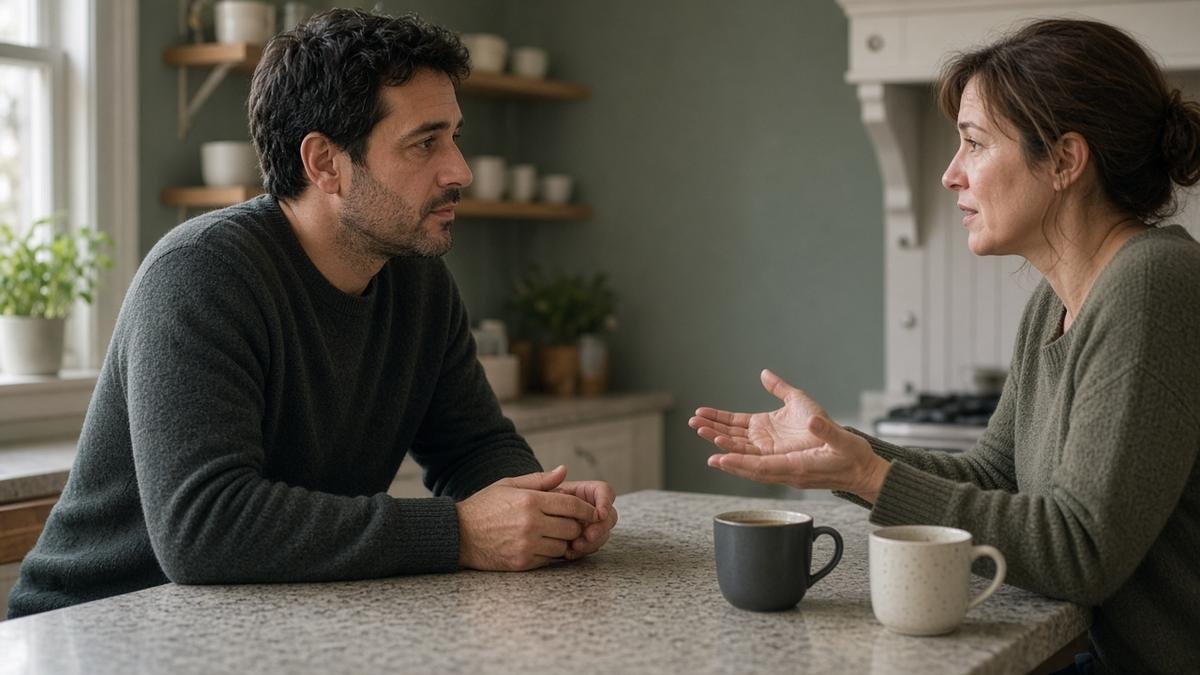
Soft Talk vs Hard Talk
| Moment | Likely to cause a fight | Likely to open a conversation |
|---|---|---|
| Timing | Late at night, in the middle of a stressful task | A planned, calm window with no distractions |
| First sentence | “We need to talk about your behavior.” | “I care about us, and I want to talk about something.” |
| Language | “You always” and “You never” | “I feel” and “I would like” |
| Listening | Planning a reply while the other speaks | Repeating back what you heard |
| Ending | Silence, slammed doors or unresolved tension | One agreed step and a time to follow up |
Watch Your Body, Not Just Your Words
Anger and anxiety live in the body first. If your hands shake or your voice rises, your brain is no longer in a good place to solve problems. The American Psychological Association offers helpful ideas on controlling anger before it controls you. A good rule for couples is to agree on a pause signal in advance. Either person can use it, and the break lasts at least 20 minutes, with a promise to return.
During the pause, do something calming that has nothing to do with the argument. Walk, breathe slowly, or drink water. Do not rehearse your best comeback in your head, because that keeps your body in fight mode.

When the Problem Is Bigger Than the Conversation
Sometimes the issue is not the topic but the stress around it, such as money, parenting load or health worries. In those cases, name the stress first. Our guide on financial stress in relationships shows how money pressure can show up as arguments about something else. If you feel that talking has stopped working, a few sessions with a therapist can give you a safe space to practice.
Watch a Real Example
Dr. Julie Gottman explains how to raise a complaint without hurting your partner in this short video.

Quick Checklist Before You Speak
- Is this the right time for both of us?
- Can I say it in one or two sentences?
- Am I describing a feeling or throwing a label?
- What small change am I asking for?
Keep practicing, and be kind with yourselves when a talk goes badly. If you want a broader guide to habits that protect your bond, see how couples can keep their relationship healthy.
A Short Example Conversation
Imagine Maya is worried that Sam spends most evenings on his laptop. A fight-prone version would be, “You care more about work than me.” Here is a calmer version:
Maya: “Do you have a few minutes after dinner? I want to talk about our evenings. It is nothing scary.”
Sam: “Sure. What is on your mind?”
Maya: “When we are both online at night, I feel a bit lonely, and I miss talking with you. Could we keep two evenings screen-free?”
Sam: “I did not realize. I have been stressed about a deadline. I can do Tuesday and Thursday.”
Notice that nobody was blamed, a feeling was named and a small step was agreed. That is the whole method in a nutshell.
Frequently Asked Questions
Is it normal to fight every time we bring up a problem?
It is common, but it is not a sentence. Most couples have a few topics that heat up fast. The pattern usually comes from the way the topic is raised, not from the problem itself. Changing the opening, the timing and the pace often changes the outcome.
How do I bring up a problem if my partner shuts down?
Keep the first message short, kind and specific, and agree on a time to talk. A partner who withdraws usually feels flooded, so shorter talks with a clear end time feel safer than one long confrontation.
What if I am the one who gets angry quickly?
Notice your early signs, such as a tight jaw or a fast heartbeat, and ask for a pause before you say something sharp. A 20-minute break to calm down is a skill, not an escape, as long as you come back to the conversation.
How often should couples have a relationship check-in?
Many couples do well with a short weekly check-in of 20 to 30 minutes. Regular small talks stop problems from piling up into one big, emotional discussion.
When should we ask a professional for help?
If every talk ends in contempt, silence for days, or fear, a counselor can help. Read our guide to signs your relationship needs professional help to see whether it is time.