


De-escalation strategies for couples are the skills that keep a disagreement from becoming a rupture. You do not need a perfect personality. You need a pause button, softer language, and a way back to each other when bodies go into fight-or-flight.
What De-Escalation Strategies for Couples Actually Do
Gottman research shows that a break of about twenty minutes, used for self-soothing rather than rehearsing the fight, can change the next conversation (Gottman couples research). Soft startups and repair attempts then have room to work.
A Practical De-Escalation Sequence
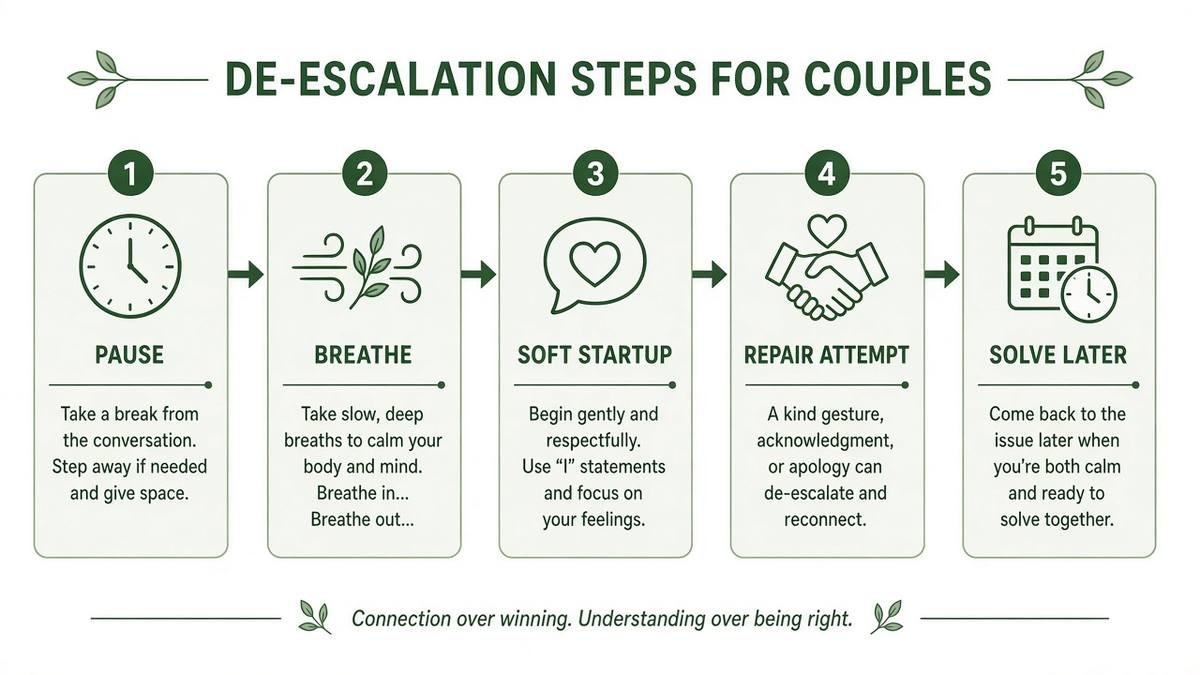
- Notice flooding signs: racing heart, tunnel vision, urge to win.
- Call a timed pause with a return time.
- Self-soothe: walk, water, music, not social media rage-scrolling.
- Reopen with a soft startup and one issue only.
- Use a repair phrase early if tone slips.

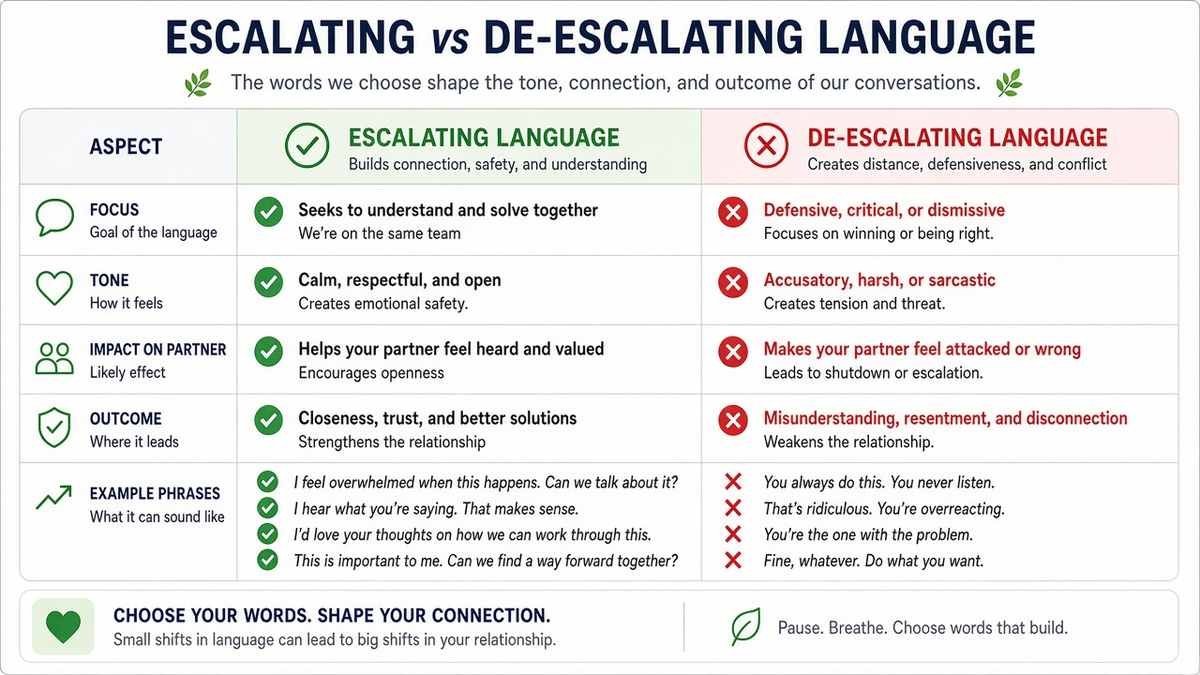
| Escalating move | De-escalating swap |
|---|---|
| “You always ignore me.” | “I felt alone when plans changed without a text.” |
| Bringing up five old fights | Staying on today’s topic |
| Following a partner from room to room | Agreeing on a 20-minute pause |
| Sarcasm | “I am flooded. I care about this and need a reset.” |
How to Pause Without Triggering Your Partner
Ending a conversation mid-flood is delicate. Clear timing and reassurance prevent the pause from feeling like punishment.
Manager Skills Couples Can Borrow Without Making Home a Workplace
People sometimes learn calm tactics at work and forget them at home. Bring home the useful parts only: one agenda item, respectful tone, and a written next step. Leave performance reviews out of your marriage.
For more conflict tools, see healthy ways to resolve conflict with someone you love and how to resolve small arguments early.

Three Skills That Stop Argument Spirals
De-escalation is a practice. Couples get better when they rehearse repair phrases on calm days, not only in crisis.
Teaching De-Escalation to Your Household
De-escalation strategies for couples work better when the whole household understands calm is valued. Agree that raised voices mean a pause, not a chance to score points. Teach kids age-appropriate versions: take space, breathe, come back. Adults must model the return, because children watch whether promises are kept.
Create a calm corner with water, a notebook, and a phone charger away from argument spaces. Physical design supports emotional strategy. After heated evenings, do a five-minute recap: What triggered us? Which de-escalation strategy helped? What will we try next time? Learning logs turn pain into skill.
Remember that some topics need professional mediation. De-escalation is not a substitute for therapy when trauma, addiction, or abuse dynamics are present. Use these tools for everyday conflict and escalate support when patterns stay dangerous or stuck.
De-Escalation Strategies for Couples in High-Stakes Topics
Money, parenting, fidelity fears, and in-law boundaries escalate quickly. Use a pre-talk checklist: Are we fed? Is there childcare coverage? Do we have forty uninterrupted minutes? If not, schedule the talk. De-escalation strategies for couples include preventing needless ignition.
Open with unity: “We are on the same team against the problem.” Then state one fear and one hope each. Fears humanize. Hopes orient. Only then move into options. Couples who jump to solutions while still flooded choose poorly and fight about the choice later.
If voices rise, point to your shared pause agreement without shaming. Shame re-escalates. Neutrality helps: “We hit our pause rule. See you in twenty.” During the break, avoid recruiting friends as jurors. Venting to allies can harden positions before repair.
After reconvening, rate intensity from one to ten. If either person is above six, extend the break. Ego wants to finish; wisdom wants conditions for finishing well. Ending a talk early with a calendar invite is a win when it prevents damage.
Keep a written log of what de-escalation strategies for couples worked. Maybe a walk works better than sitting. Maybe tea helps. Personalized tactics beat generic advice. Revisit the log after each hard week so skills stay conscious.
Advanced De-Escalation Strategies for Couples
De-escalation strategies for couples work best when both people agree on rules before the next fight. Write three agreements: a pause phrase, a minimum break length, and a reunion ritual such as water and a walk around the block. Practice once while calm so the words feel familiar under stress.
Body first, story second. When heart rate spikes, complex reasoning drops. That is biology, not moral failure. Cool the body with longer exhales, a cold splash of water, or a brisk walk. Then return to the story of what happened. Couples who respect physiology stop calling each other dramatic for needing a break.
Use “structured speaking” after a pause: one person talks for two minutes while the other takes notes and paraphrases. Then switch. Structure prevents the verbal pile-on that restarts escalation. If children are present, move adult conflict to a private space and use a calm code word.
De-escalation is not the same as surrender. You can lower volume and still hold a boundary: “I will not continue while we are yelling. I will talk at 8:00.” Clarity plus calm is strength. Related help: recovering after a difficult argument and resolving small arguments early.
When de-escalation fails
If one partner pursues while the other flees every time, you may need a therapist to interrupt the cycle. If insults, threats, or intimidation appear, de-escalation tactics are not enough. Safety planning comes first. Love does not require enduring harm.
For couples who escalate around specific topics like money or in-laws, schedule those talks with an agenda and a time box. Timed talks reduce the fear that the conversation will consume the whole night. End with one agreement and one appreciation, even if the topic remains unfinished.
Frequently Asked Questions
What if my partner refuses timeouts?
Explain flooding in plain language and propose a written agreement. If refusal is controlling, get outside support.
How long should a de-escalation break be?
Often 20 to 30 minutes minimum for bodies to settle. Agree on a maximum too.
Is walking away the same as stonewalling?
Stonewalling shuts down with no plan to return. A pause includes reassurance and a time.
Can de-escalation strategies for couples work by text?
Yes for logistics. Save deeper repair for voice or in person when possible.
Continue with recovering emotionally after a difficult argument.