



Difficult conversations with your partner are unavoidable in a real relationship: money, intimacy, in-laws, parenting, and unmet expectations. The goal is not to avoid discomfort. The goal is to reduce tension, protect trust, and leave the talk with a clearer next step.
How to Approach Difficult Conversations with Your Partner
Soft startups and repair attempts are repeatedly linked with healthier conflict trajectories in couples research (Gottman: soft startup). Timing matters too. Tired, hungry, or rushed brains escalate faster.

A Five-Part Process for Hard Talks
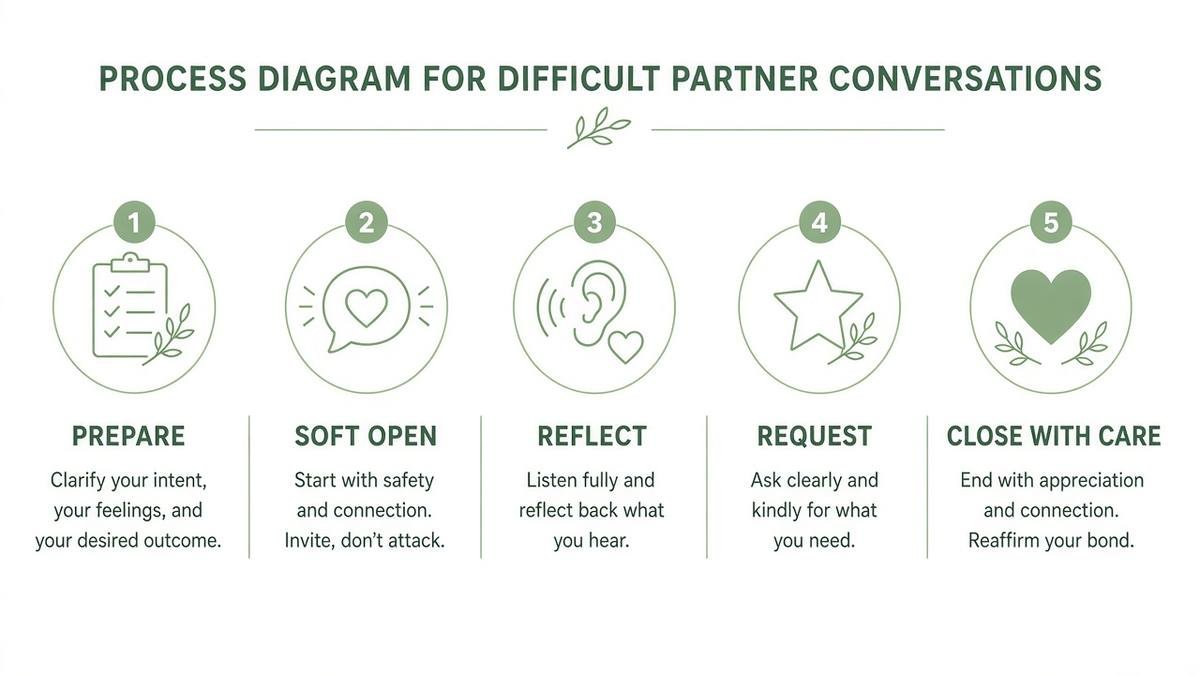

- Prepare: write the feeling, the specific event, and the ask.
- Soft open: “I feel anxious about our budget talk and I need a plan.”
- Reflect: summarize your partner’s view before you counter.
- Request: one behavior, one timeframe.
- Close: appreciate effort and schedule follow-up if needed.
| Do | Don’t |
|---|---|
| Use “I feel… when… I need…” | Use “you never” or “you always” |
| Pick one topic | Kitchen-sink every grievance |
| Pause if flooded | Demand a resolution while shaking |
| Thank any repair attempt | Mock softness as weakness |
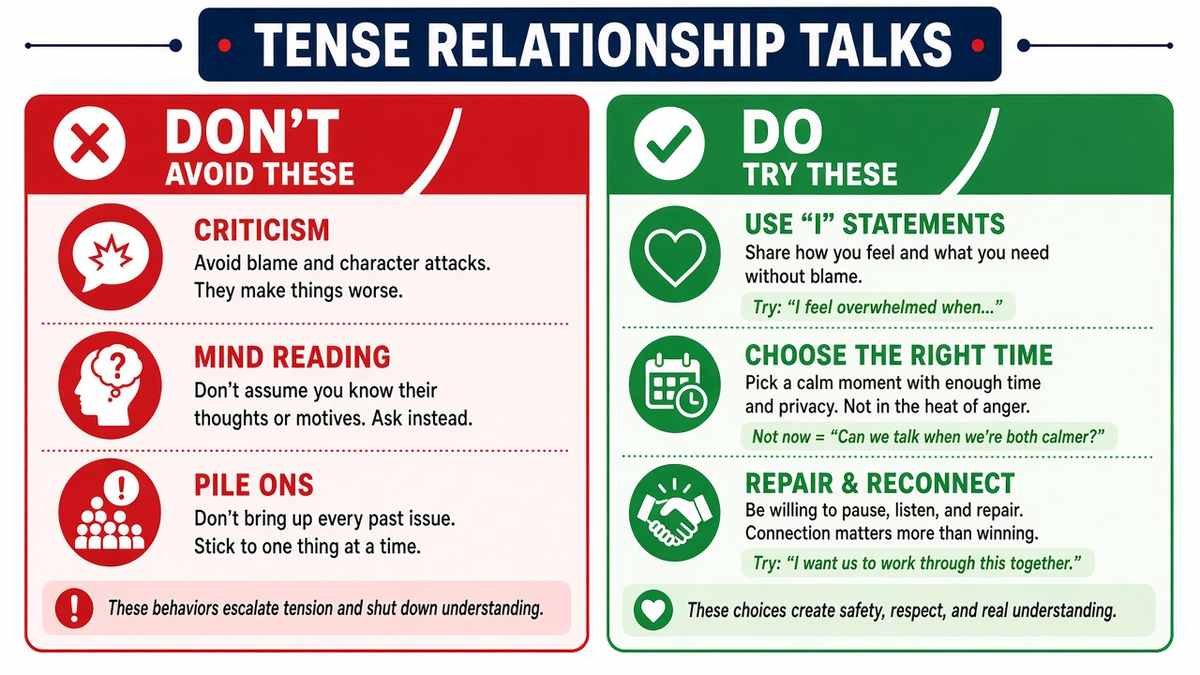
How Repair Works in Real Relationships
Repair is the skill that lets hard topics stay on the table without destroying the bond.
Trust-Protecting Moves During Tension
Separate impact from intent
Your partner may not have meant harm. You still get to name impact. “I know you were joking, and I felt small” holds both truths.
Build related skills with how to disagree without hurting them and how to talk about money with your partner.

Emotional Flooding and Anxiety in Relationships
If either of you floods easily, learn the body signs early. A planned pause protects the conversation you both still need to finish.
Aftercare Following Difficult Conversations with Your Partner
Difficult conversations with your partner do not end when the talking stops. Aftercare decides whether trust rises or drops. Plan a gentle landing: shared snack, short walk, or sitting side by side without rehashing. The body needs proof that intimacy survived honesty.
Next-day follow-through matters. If you promised a budget spreadsheet or a schedule change, deliver a visible first step within twenty-four hours. Broken micro-promises poison future hard talks. Conversely, quick follow-through makes the next difficult conversation with your partner feel safer to start.
Also debrief the process, not only the content. Ask, “Did we stay respectful? Did anyone feel cornered?” Process feedback improves the method. Couples who refine how they talk eventually spend less time repairing how they talked and more time living the agreements they made.
Building Confidence for Difficult Conversations with Your Partner
Many people avoid difficult conversations with your partner because they fear abandonment or explosion. Confidence grows through graded practice. Start with a low-stakes preference talk, then move to medium topics, then high stakes. Success at lower levels teaches your body that hard talks can end safely.
Prepare emotionally as well as verbally. Eat, hydrate, and decide your minimum acceptable outcome. A minimum might be “we schedule a follow-up,” not “we solve the entire issue tonight.” Realistic goals reduce desperation, and desperation fuels pressure that your partner feels as attack.
If your partner stonewalls, describe the impact and invite a medium they can handle: “If talking is too much, can we exchange short letters tonight?” Alternative formats still count as difficult conversations with your partner. The channel can flex; the honesty should not disappear.
Watch for contempt markers such as eye-rolling and mockery. Name them early: “When eyes roll, I shut down. Can we reset?” Contempt is corrosive. Catching it fast is a trust-saving move. Follow with a sincere apology process if either of you crossed a line.
End hard talks with appreciation for courage. Thanking effort reinforces the behavior you want repeated. Couples who only critique the content of a talk forget to reinforce the bravery of having it.
Scripts for Difficult Conversations with Your Partner
Difficult conversations with your partner go better with prepared language. Try: “I want to bring up something that matters to me. Is now okay, or should we pick a time tonight?” Consent to timing is already a trust move. If they say later, calendar it so the issue does not vanish.
For recurring issues: “We have circled this before. I am not trying to attack you. I need a two-week experiment so we can learn what works.” Experiments beat ultimatums. Define success metrics: fewer raised voices, shared calendar updates, or one date night protected.
When the topic is intimacy: speak in needs and preferences, not defects. “I miss feeling close” invites collaboration. “You never want me” invites shame. Shame escalates; longing can connect. Keep medical or trauma factors in view and seek specialists when needed.
When the topic is money: bring numbers, not character labels. Sit side by side looking at the same screen. Shared visual data lowers blame. Pair the talk with how to talk about money with your partner for more structure.
Repairing trust mid-conversation
If either of you gets sharp, repair immediately: “That came out harsher than I meant. Let me try again.” Mid-course corrections teach your partner that hard talks can stay safe. Afterward, do a five-minute reconnect: tea, a short walk, or a light show. The nervous system needs proof that conflict did not erase affection.
Document agreements in a shared note. Memory is biased after conflict. Written clarity prevents the next difficult conversation with your partner from restarting at zero. Review the note a week later and celebrate any progress, even partial.
Keep a shared note titled Hard Talk Wins. After each difficult conversation with your partner, write one thing that went better than last time. Progress becomes visible, and visible progress reduces dread the next time a hard topic appears.
Frequently Asked Questions
How do I start difficult conversations with your partner about recurring issues?
Open with appreciation, name the pattern briefly, and ask for a collaborative experiment for two weeks.
What if my partner shuts down?
Reduce intensity, offer a break with a return time, and switch to writing if speech is too hard.
Should we use a mediator or therapist?
Yes when the same fight loops, contempt appears, or either person feels unsafe.
How do we end the talk well?
Summarize agreements, thank effort, and do one small connecting action afterward.
More support: how to apologize after a serious argument.